One of the most common questions Toronto sellers ask is whether to go vacant or occupied with their staging. The answer is almost never obvious, it depends on your property type, your timeline, and what's actually in the house right now. This guide cuts through the confusion so you can make the right call before listing.
In This Guide
- What's the difference between vacant and occupied staging?
- When is vacant staging the better choice?
- When is occupied staging the better choice?
- What about partially occupied properties?
- Cost comparison: vacant vs. occupied staging in Toronto
- Which approach sells faster?
- Making the final decision
- Frequently asked questions
What's the difference between vacant and occupied staging?
Direct Answer
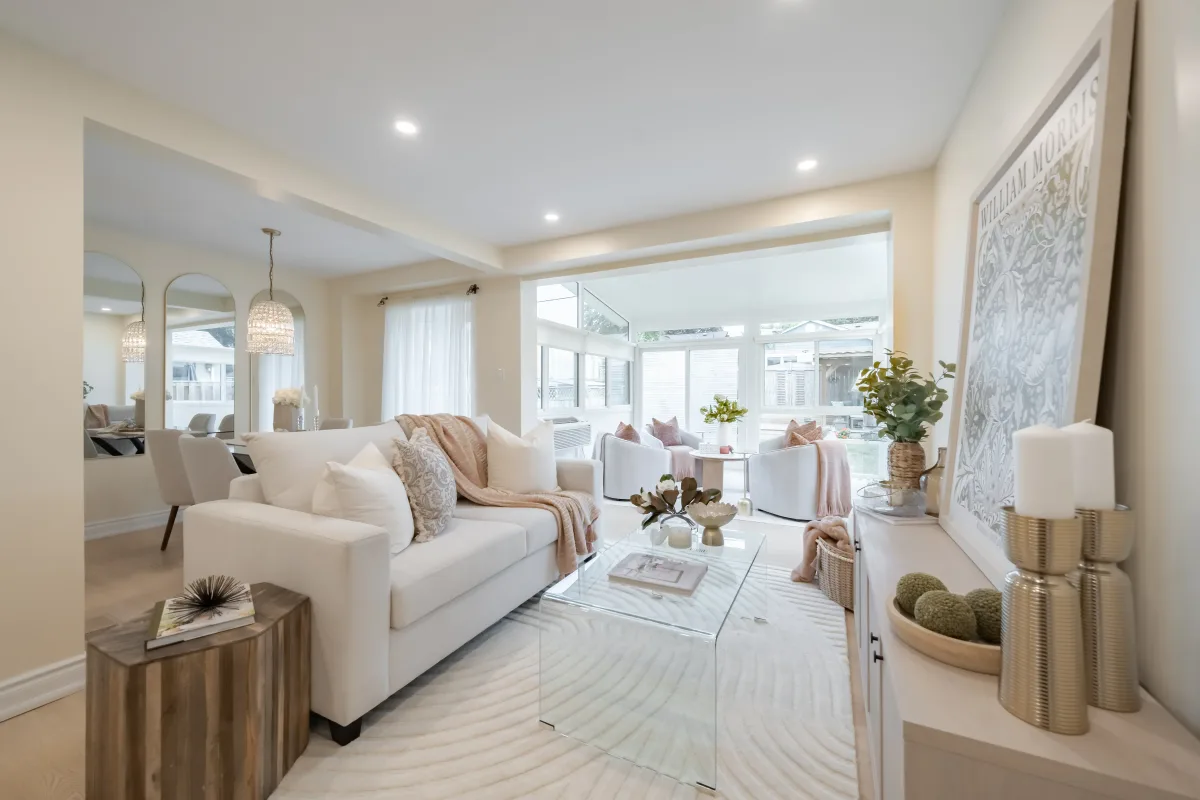
Vacant staging means the property is empty and the stager furnishes it completely from an inventory warehouse. Occupied staging means the seller is still living there. The stager works with the existing furniture, editing, rearranging, and supplementing with rented pieces where needed. Both produce staged listings. The difference is in scope, cost, and process.
Vacant staging starts from zero. When a property is empty, the stager selects every piece of furniture, every accessory, every piece of artwork from their warehouse inventory. A crew delivers it all on staging day and installs it from scratch. The result is a property where every visual decision has been made intentionally. There's nothing from the seller's life competing with the presentation. The stager has complete control over how the space looks and photographs.
Occupied staging works within constraints. The stager arrives at a property where furniture is already in place and a household is still functioning. Their job is to identify what's working, remove what isn't, rearrange what's salvageable, and supplement with rented pieces (a new coffee table, a better-scaled sofa, artwork for the main wall) where the existing contents fall short. It requires more judgement and more client coordination, but costs less because the stager's inventory contributes fewer pieces.
Both approaches are legitimate. Both are photographed the same way: professional photography on the same day, with the stager present to make sure every shot is set up correctly. Both use professional inventory. The question is which approach is right for your specific property, and the answer depends on a handful of concrete factors that this guide covers in full.
It's also worth noting what staging is not, in either form. Staging is not decorating. It is not about expressing the seller's personal taste. It is a sales tool. Its purpose is to help buyers see themselves in the space and to eliminate every possible objection before an offer is made. A stager's decisions are driven by buyer psychology and market expectations, not by what the seller finds attractive.
When is vacant staging the better choice?
Vacant staging is the right approach in a predictable set of circumstances. If any of the following apply to your property, vacant staging should be the default recommendation.
The property is already empty
If the seller has moved out, or if the property is an investment unit the seller never lived in, vacant staging is the only viable option for a professional presentation. An empty property left unstaged has a well-documented problem: buyers cannot calibrate room size, cannot imagine how they would live in the space, and photographs of empty rooms fail to create the emotional connection that drives offer decisions. In Toronto's current market, vacant staging almost always outperforms leaving a vacant property empty. The ROI on furnishing an empty home is very high relative to the listing cost involved.
The existing furniture is dated, damaged, or the wrong scale
Not all furniture can be worked with. If the seller's contents include pieces that are visually dominant and hard to move around, a sectional that fills the living room wall-to-wall, a bedroom set in a wood finish that reads as twenty years old, appliances in an avocado colour that photographs as a renovation liability: occupied staging will fight a losing battle. In these cases, the cost of removing the problematic pieces, storing them, and bringing in replacement inventory is often comparable to a full vacant staging. The better call is to plan a full vacant package from the start.
The property is luxury tier
Buyers at the $2 million and above price point have a specific set of expectations. They've toured new construction with professional showsuite staging. They've seen luxury resale listings presented at the highest level. A property at this tier presented with an occupied staging, particularly one where some of the furniture is showing its age, competes poorly against that mental benchmark. Luxury vacant staging with premium inventory is almost always the right answer for high-end Toronto listings, particularly detached homes in Leaside, Rosedale, Forest Hill, Lawrence Park, and the Annex.
The seller has moved into a new home and left the old property behind
When a seller has purchased before selling, the old property is typically cleared out, either fully or partially, as the seller moves their preferred furniture to the new home. What's left behind tends to be the pieces they didn't want: furniture that didn't fit the new space, items relegated to secondary rooms, pieces in poor condition. This is exactly the inventory that occupied staging cannot work with effectively. A vacant staging is the cleaner solution.
The layout is complex
Some properties (open-plan lofts, unusual floor plans, heritage conversions with odd proportions) genuinely require a professional furniture selection to define and communicate the space. When a buyer walks into an empty loft with twenty-foot ceilings and no visual anchors, the space feels ambiguous and underscaled at the same time. Vacant staging defines the zones, sets the scale, and gives buyers a clear mental map of how the property functions. This is difficult to achieve with occupied staging, which inherits the scale decisions the seller made when they were living in the space.
The seller has pets or young children
Showing an occupied home with pets or young children adds logistical complexity to every showing: the home needs to be cleared, the pets need to be removed, the children's belongings need to be tidied. Over a multi-week listing period, this becomes genuinely burdensome. When the property is large enough and the budget supports it, moving the family to temporary accommodation and staging the property vacant removes that burden entirely, and delivers a cleaner, more consistent presentation across every showing.
When is occupied staging the better choice?
Occupied staging is the right call when the existing furniture can genuinely contribute to the presentation rather than work against it. Here's when to choose it.
The seller is still living in the property
The most common scenario for occupied staging is straightforward: the seller cannot or does not want to vacate before listing. Perhaps the new home isn't ready. Perhaps temporary accommodation isn't practical. In this case, occupied staging is the path forward, and when done well, it can produce excellent results. The key variable is whether the existing furniture gives the stager enough to work with.
The existing furniture is in good condition and the right scale
A contemporary sofa in a neutral tone, a well-proportioned dining table, bedroom furniture that presents cleanly: this is the occupied stager's ideal raw material. When the bones are good, professional editing and rearrangement can transform a room that the seller thought was already fine into a room that photographs significantly better than it did before. The stager's value here is in proportion, flow, and the removal of things that are subtly working against the space.
The property is a well-maintained condo
Contemporary condo sellers who have kept their units in good shape are strong candidates for occupied staging. Many Toronto condos built in the last ten to fifteen years have modern finishes, open-plan layouts, and contemporary furniture that responds well to professional editing. An occupied staging consult and selective supplementation (a better coffee table, a large-format piece of artwork, a pair of bedside lamps) can elevate a well-maintained condo to a listing-quality presentation at a cost that is meaningfully lower than full vacant staging.
Budget is a consideration
Occupied staging costs less than vacant staging because less inventory is involved. For sellers who need to manage their pre-sale spend carefully, occupied staging offers a professional result at a lower price point. The tradeoff is less visual control and a result that is partly constrained by what the seller already owns. For many properties, the tradeoff is worth it.
The timeline is tight
Occupied staging can often be executed in a half-day. When a seller needs to list quickly, within a week of making the decision, occupied staging may be the only viable option. A vacant staging requires inventory selection, scheduling a delivery crew, and coordinating building access if it's a condo. Occupied staging requires none of that logistics at the same scale and can be turned around very quickly once the consultation is booked.
The key question for occupied staging is honest: does the existing furniture help or hurt? A good stager will tell you directly. If the answer is that the furniture is working against the property, the right response is to reconsider, either moving to a partial or full vacant staging, or budgeting for the supplemental inventory needed to compensate for what doesn't work.
What about partially occupied properties?
Direct Answer
Many Toronto listings fall into a middle category, the seller has taken some furniture when they moved out, or is in the process of moving. Partial staging (also called hybrid staging) is often the most cost-effective solution: the stager furnishes empty rooms from inventory while editing and supplementing rooms that still have contents.
The partial staging scenario is more common than most sellers expect. A seller has moved out but left the dining table because it didn't fit the new space. A bedroom set is still in place but the living room is empty. An investment property has been cleared by the departing tenant but some built-in shelving and appliances remain. In all of these cases, a room-by-room assessment is the right starting point, not a blanket decision to go vacant or occupied across the entire property.
How partial staging works in practice: the stager walks the property before quoting and assesses each room individually. Rooms that are already clear get a full furniture package from inventory. Rooms that have contents get an occupied staging edit, remove the pieces that aren't working, rearrange what remains, and supplement from inventory where needed. The result is often close to a full vacant staging quality at a meaningfully lower cost, because the stager isn't starting from zero in every room.
Kelly Allan Design handles partial staging regularly and has extensive experience with the hybrid approach. Every partial staging is assessed on a room-by-room basis during the initial quote walk-through. The quote will specify exactly which rooms are being furnished from inventory, which are being edited, and what supplemental pieces are being brought in, so there are no surprises on staging day.
If you're in a transition situation, mid-move, partially cleared, or dealing with a property that's been partially emptied by a tenant, request a quote walk-through before making any decision about approach. The right answer is usually clearer in person than it is in theory.
What does vacant vs. occupied staging cost in Toronto in 2026?
Direct Answer
Occupied staging in Toronto typically costs $1,000–$2,500 for a consultation and edit, depending on property size and how many rented pieces are brought in. Vacant staging costs $2,500–$8,000+ depending on the size of the property and number of rooms staged. The gap reflects the difference in labour and inventory involved. For a complete breakdown across all property types, see our Toronto home staging cost guide.
| Staging Type & Scope | Typical Cost (2026) | Notes |
|---|---|---|
| Occupied staging, condo or small house (consult + edit) | $1,000 – $1,500 | Minimal or no supplemental inventory. Primarily editing and rearranging existing contents. |
| Occupied staging, with supplemental furniture | $1,500 – $2,500 | Includes rented pieces (artwork, tables, lamps, accessories) added to supplement existing furnishings. |
| Vacant staging: 1-bedroom condo | $2,000 – $3,000 | Full furniture package: living, bedroom, kitchen/dining. 5-week rental included. |
| Vacant staging: 2-bedroom condo | $2,500 – $4,500 | All principal rooms staged. Den or second bedroom included. |
| Vacant staging, detached 3-bedroom house | $3,000 – $6,000 | Main floor + all bedrooms. Larger inventory requirement and crew. |
| Vacant staging, luxury or 4-bedroom+ | $5,500 – $8,500+ | Premium inventory, multiple days, full home presentation. |
All Kelly Allan Design quotes are fixed-price. There are no additions after the project starts, the number in your quote is the number you pay. This applies to both vacant and occupied stagings. For a full breakdown of what drives staging costs, including the difference between occupied, vacant, and partial approaches across condos, semis, and detached homes, see our 2026 Toronto home staging cost guide.
It's worth considering cost in relation to outcome, not in isolation. A vacant staging at $4,500 on a $1,100,000 property represents approximately 0.4 percent of the sale price. The documented premium for staged versus unstaged properties in the Toronto market typically runs 5 to 10 percent over list price, which on a $1.1 million property is $55,000 to $110,000. The math on staging ROI is not subtle, regardless of which approach you choose.
Which approach sells faster, vacant or occupied staging?
Direct Answer
A well-executed vacant staging typically produces cleaner photography, stronger first impressions, and faster offers than an occupied staging of the same property, but only when the staging quality is high. The stager's skill matters more than the approach. In Toronto, the fastest-selling staged properties are almost always vacant, but poorly planned vacant stagings can underperform well-executed occupied stagings.
The data on staging speed is consistent and significant. According to the National Association of Realtors 2025 Profile of Home Staging, staged homes sell 73 percent faster than unstaged homes. The Real Estate Staging Association's data shows that vacant homes that go unstaged sell 86 percent slower than staged vacant homes, meaning leaving a vacant property empty is one of the most costly presentation decisions a seller can make in the current market.
Vacant staging has a specific speed advantage: the photography is cleaner. When a property is fully staged from inventory, every piece of furniture is selected for scale, colour, and positioning. There's no clutter, no personal items, no mismatched pieces. The resulting listing photos present the property at its absolute best, and since buyers are shortlisting properties based on photos before scheduling showings, that listing photo quality directly translates into showing volume and, ultimately, offer pace.
Occupied staging introduces variables. Even a very good occupied staging is working within the constraints of what the seller owns. Personal items can reappear between the stager's visit and the photography shoot. Furniture that was rearranged can drift back to its original position. Sellers have a natural tendency to put things back where they were. Managing this takes discipline and good communication with the seller, and experienced stagers build this into their process.
The honest answer about speed is this: the difference between a well-staged vacant property and a well-staged occupied property is smaller than the difference between a well-staged property of either type and an unstaged or poorly staged property. If you're choosing between a high-quality occupied staging and skipping staging entirely, staging wins by a very large margin. If you're choosing between vacant and occupied staging both executed well, vacant staging has a consistent edge, but it's a finer distinction than many sellers assume.
How do I decide between vacant and occupied staging?
Use this decision framework to arrive at the right approach for your property. Answer the questions in order, the first that applies to your situation typically determines the answer.
Is the property currently vacant?
If yes: vacant staging, full package. An empty property without professional staging is one of the most common and most costly presentation mistakes in the Toronto market. Do not list a vacant property unstaged.
Is the furniture contemporary, well-maintained, and the right scale for the rooms?
If yes: occupied staging with a professional edit is likely the right call. Book a consultation, have the stager walk the property, and get a quote for occupied staging with selective supplementation.
Is the furniture dated, oversized, or in poor condition?
If yes: this is the judgment call. If the problematic pieces can be easily moved into storage and the remaining inventory gives the stager something to work with, occupied staging with significant supplementation may still be viable. If the majority of the furniture is working against the property, vacant staging, or at minimum partial staging, will produce a better result.
Is the property luxury tier ($2M+)?
If yes: vacant staging, almost always. Buyers in this price range have high visual expectations and will compare your listing against professional showsuite presentations. Occupied staging with even very nice furniture is unlikely to match that benchmark.
Is the budget very tight?
If yes: occupied staging or partial staging. A professional occupied staging at $1,200 will outperform no staging by a very large margin. Focus the budget on the rooms that matter most, living room and primary bedroom, and make sure those rooms are presented at the highest possible level.
Is the timeline under two weeks?
Both approaches are possible. Occupied staging can often be completed in a single day once the consultation is done. Vacant staging requires 1 to 2 days for installation once inventory is selected and the crew is scheduled. Kelly Allan Design accommodates tight timelines regularly, contact us with your listing date and we'll confirm what's possible.
If you're still uncertain after working through this framework, the most reliable path is a complimentary consultation. A stager who has walked the property can give you a straight recommendation in fifteen minutes. That conversation is free and will answer the question more reliably than any checklist.
Not sure which approach is right for your property?
We'll assess it and give you a straight answer. Fixed-price quotes within 1 business day.
Get a Free Estimate